


-

Lawrence Weiner (American, 1942–2021), UNTIL THE MOON COMES OVER THE MOUNTAIN, 1994. Language and the materials referred to. Collection Glenn and Amanda Fuhrman NY, Courtesy The FLAG Art Foundation and the Lawrence Weiner Estate. Photo: Jenny Gorman.

-
Lawrence Weiner (American, 1942–2021), UNTIL THE MOON COMES OVER THE MOUNTAIN, 1994. Language and the materials referred to. Collection Glenn and Amanda Fuhrman NY, Courtesy The FLAG Art Foundation and the Lawrence Weiner Estate. Photo: Jenny Gorman.
-
Lawrence Weiner (American, 1942–2021), UNTIL THE MOON COMES OVER THE MOUNTAIN, 1994. Language and the materials referred to. Collection Glenn and Amanda Fuhrman NY, Courtesy The FLAG Art Foundation and the Lawrence Weiner Estate. Photo: Jenny Gorman.
-
Lawrence Weiner (American, 1942–2021), UNTIL THE MOON COMES OVER THE MOUNTAIN, 1994. Language and the materials referred to. Collection Glenn and Amanda Fuhrman NY, Courtesy The FLAG Art Foundation and the Lawrence Weiner Estate. Photo: Jenny Gorman.
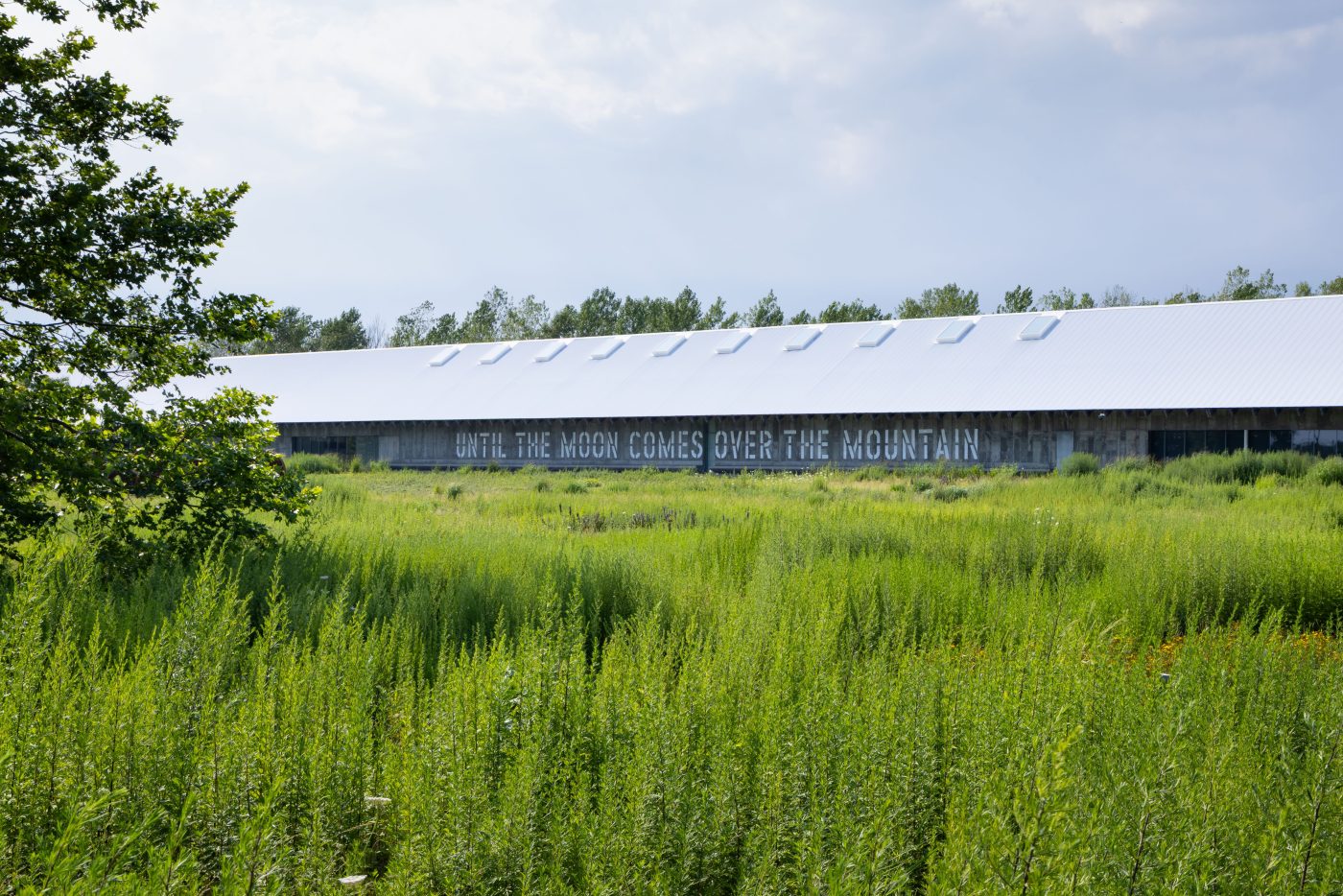


Lawrence Weiner (American, 1942–2021) was a central figure in the development of what came to be known as the Conceptual Art movement. In the late 1960s, he abandoned painting to build an oeuvre around the sculptural possibilities of language. “When you are dealing with language, there is no edge that the picture drops over or drops off,” Weiner explained. “You are dealing with something completely infinite. Language, because it is the most nonobjective thing we have ever developed in this world, never stops.” Primarily taking the form of words installed along walls, windows, and rooftops, his works are adaptable to their specific settings and can be shown simultaneously across multiple locations.
Weiner’s 1994 piece UNTIL THE MOON COMES OVER THE MOUNTAIN is presented boldly across the Parrish Art Museum’s south façade. As with all of Weiner’s work, the medium line is described as “language + the materials referred to,” reinforcing the artist’s understanding of these text-based pieces as sculpture. By centering his practice on words and their interpretation, Weiner emphasizes the viewer as essential to completing the work, which consists not only of the phrase itself, but also what it might evoke for the individual—in this case, their moon, their mountain, an unspecified duration of time, and one’s personal experience in relation to it all.
This installation was originally mounted as part of the group exhibition entitled UNTIL THE MOON COMES OVER THE MOUNTAIN (August 1–November 8, 2026), co-organized by the Parrish Art Museum and The FLAG Art Foundation. Titled after Weiner’s work, the exhibition presented artists who work with abstraction to explore landscape, natural materials, and relationship to place.
Lawrence Weiner: UNTIL THE MOON COMES OVER THE MOUNTAIN is organized by Scout Hutchinson, The FLAG Art Foundation Associate Curator of Contemporary Art at the Parrish, and Jonathan Rider, FLAG’s Director, with Caroline Cassidy, FLAG’s Deputy Director.
Exhibition Support
Lawrence Weiner: UNTIL THE MOON COMES OVER THE MOUNTAIN is made possible, in part, thanks to the generous support of The FLAG Art Foundation.
We are also grateful for the in-kind support provided by Duggal Visual Solutions.
The Parrish Art Museum’s programs are made possible, in part, by the New York State Council on the Arts with the support of Governor Kathy Hochul and the New York State Legislature, and by the property taxpayers from the Southampton Union Free School District and the Tuckahoe Common School District.
About Lawrence Weiner
Born and raised in the Bronx, New York, Lawrence Weiner attended the city’s public schools and studied philosophy, theatre, and religion at the Lehman Branch of City University of New York (Hunter-North). Initially working with shaped canvases and architectural interventions, his 1968 “Declaration of Intent” marked a new direction in his approach to artmaking. In this statement, he shifts the traditional artist-object-viewer relationship by positioning the viewer in a central role:
- THE ARTIST MAY CONSTRUCT THE WORK
- THE WORK MAY BE FABRICATED
- THE WORK NEED NOT BE BUILT
EACH BEING EQUAL AND CONSISTENT WITH THE INTENT OF THE ARTIST
THE DECISION AS TO CONDITION RESTS WITH THE RECEIVER UPON THE OCCASION OF RECEIVERSHIP
Weiner lived and worked in his studio in New York City and, from 1970 on, on a boat in the city of Amsterdam, in Holland.
Weiner’s work has been presented in numerous national and international institutions. Significant solo exhibitions during the artist’s lifetime include The Jewish Museum, New York (2020–1); MACRO Museum, Rome (2020); KODE, Bergen (2019); Museo Nivola, Orani (2019); Berkeley Art Museum and Pacific Film Archive (2017); Milwaukee Art Museum (2017); Kunsthaus Bregenz (2016); Blenheim Palace, Woodstock (2016); Museu d’Art Contemporani de Barcelona, and Stedelijk Museum, Amsterdam (2013); Centro de Arte Contemporáneo de Málaga (2008); the Whitney Museum of American Art, New York, traveled to the Museum of Contemporary Art (MoCA), Los Angeles, and K21, Düsseldorf (2007–8); Centro de Arte Contemporáneo de Málaga (2008); Haus der Kunst, Munich (2007); Museo Tamayo, Mexico City (2004); Kunstmuseum Wolfsburg (2000); Kunsthalle Nürnberg (1997); Walker Art Center, Minneapolis (1994); San Francisco Museum of Modern Art (1992); Hirshhorn Museum and Sculpture Garden, Washington, DC (1990); Kunsthalle Bern (1989); Musee St. Pierre, Dijon (1985); The Chicago Arts Club (1985); Portikus, Frankfurt (1983); Laguna Gloria Art Museum (1976); and Van Abbemuseum, Eindhoven, and Kunsthalle Basel (1976). His work has been included in several iterations of documenta (5, 6, 7, 13) and La Biennale di Venezia (36, 41, 50, 55), and was also presented in the 27th Bienal de São Paulo.
Weiner has received numerous awards and honors, including the 2021 (received in 2022), University of Applied Arts Vienna Oskar-Kokoschka Award; the Hirshhorn Museum and Sculpture Garden New York Gala Honoree (2019); the Savannah College of Art and Design deFINE ART Honoree (2019); The Kitchen Spring Gala Honoree (2017); the Aspen Art Museum Aspen Award For Art (2017); the Wolf Foundation Wolf Prize (2017); Art Resources Transfer D.U.C. Honoree (2017); Roswitha Haftmann Foundation Prize (2014); Skowhegan Medal for Painting/Conceptual Art (1999); Guggenheim Fellowship (1994); The Arthur Koepke Prize (1991); National Endowment for the Arts Visual Artist Fellowships (1976, 1983).
About The FLAG Art Foundation
The FLAG Art Foundation is a non-collecting, nonprofit exhibition space that mounts solo, two-person, and thematic group exhibitions centering on emerging and established artists from around the globe. Organized by a diverse community of curators and thinkers within and beyond the art world, FLAG opened to the public in 2008 and has staged over 100 exhibitions celebrating the work of nearly 1,000 artists. Committed to providing education and resources for its surrounding community, and across New York City, all exhibitions and programs—including artist talks, artist-led workshops, and guided tours for school and museum groups—are free and open to the public.
The FLAG Art Foundation was founded by Glenn Fuhrman, an art patron and philanthropist, alongside his wife Amanda, a Co-Founder of The Fuhrman Family Foundation. Fuhrman is a Trustee of New York-Presbyterian Hospital, New York, NY; The Museum of Modern Art, New York, NY; and The Tate Americas Foundation, New York, NY; and is a Board Member of The Institute of Contemporary Art in Philadelphia, PA. He is also a Board Member of the 92nd Street Y, New York, NY, and The Central Park Conservancy, New York, NY.