



-

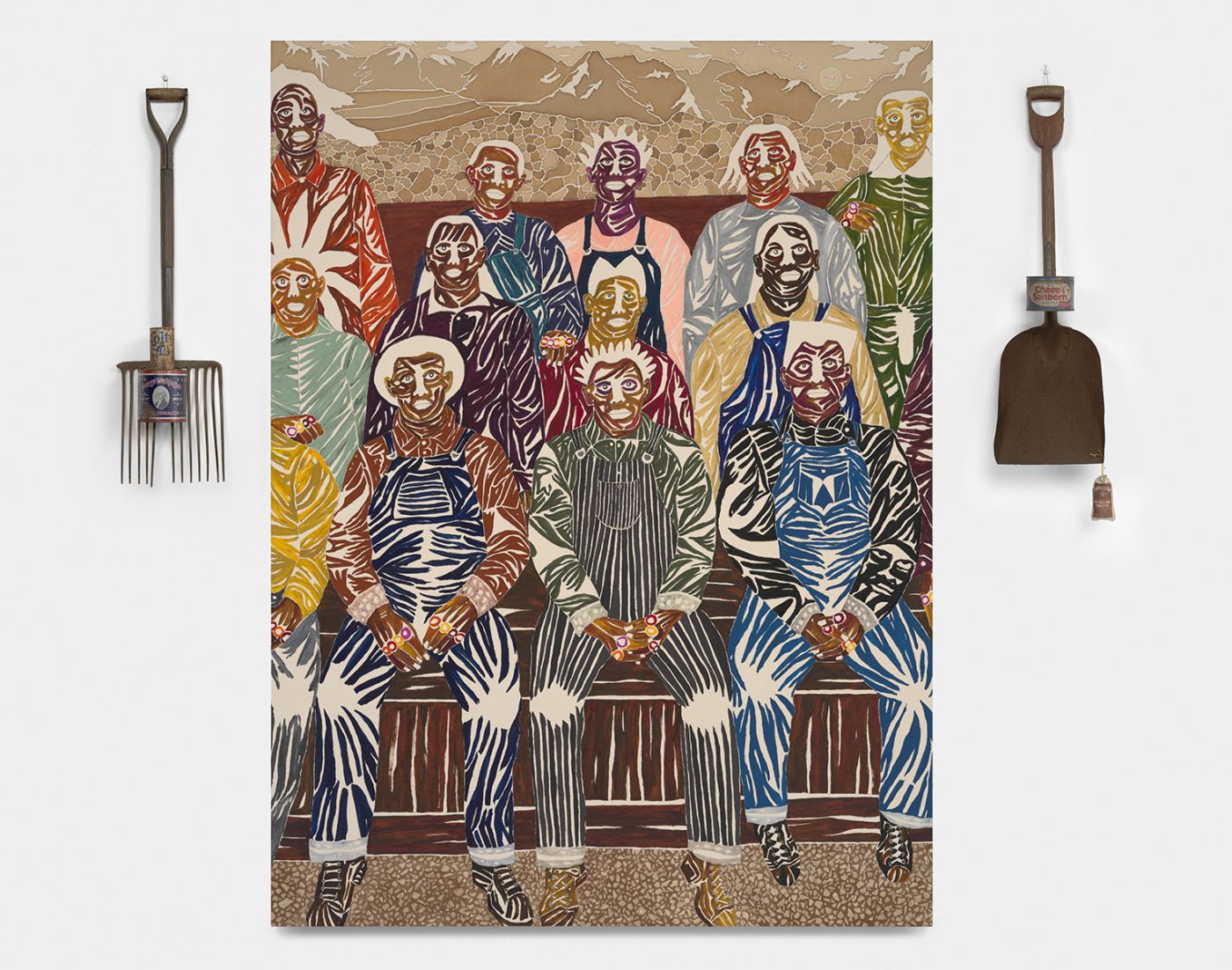
Chase Hall, The Affrilachian Mountains, 2026. Acrylic and coffee on cotton canvas, pitchfork, shovel, can, coffee canisters, tobacco pouch, and wire. Overall: 96 x 110 x 8 1/2 in. Courtesy of the artist and David Kordansky Gallery. Photography: Christopher Stach.
-

Chase Hall, Detail of The Affrilachian Mountains, 2026. Acrylic and coffee on cotton canvas, pitchfork, shovel, can, coffee canisters, tobacco pouch, and wire. Overall: 96 x 110 x 8 1/2 in. Courtesy of the artist and David Kordansky Gallery. Photography: Christopher Stach.
-

Chase Hall, The Affrilachian Mountains, 2026. Acrylic and coffee on cotton canvas, pitchfork, shovel, can, coffee canisters, tobacco pouch, and wire. Overall: 96 x 110 x 8 1/2 in. Courtesy of the artist and David Kordansky Gallery. Photography: Christopher Stach.
-
Chase Hall, Detail of The Affrilachian Mountains, 2026. Acrylic and coffee on cotton canvas, pitchfork, shovel, can, coffee canisters, tobacco pouch, and wire. Overall: 96 x 110 x 8 1/2 in. Courtesy of the artist and David Kordansky Gallery. Photography: Christopher Stach.
-

Chase Hall, The Affrilachian Mountains, 2026. Acrylic and coffee on cotton canvas, pitchfork, shovel, can, coffee canisters, tobacco pouch, and wire. Overall: 96 x 110 x 8 1/2 in. Courtesy of the artist and David Kordansky Gallery. Photography: Christopher Stach.


For the eighth iteration of the collaborative FRESH PAINT exhibition series, the Parrish Art Museum and The FLAG Art Foundation are pleased to present work by artist Chase Hall (American, b. 1993 in St. Paul, Minnesota). For his FRESH PAINT presentation, Hall will create a new painting that will be exhibited for the first time at the Parrish.
For over ten years, Hall has been creating figurative paintings that explore the multifaceted nature of life, culture, and history. Though the subjects are fictional characters born from the artist’s imagination, they also have roots in Hall’s personal experience. “A lot of these start with archetypal representations of a self seen through different narratives, landscapes, and types of people,” he explains. “Oftentimes, I’m thinking of family members or friends, brotherhood, and this idea of being and becoming.” Whether presented in more traditional portraiture or engaged in scenes of athleticism, physical labor, community gathering, and even myth and fantasy, Hall’s figures are typically depicted at life scale, imbuing them with a sense of humanity and creating a direct relationship to the viewer.
In The Affrilachian Mountains, the artist responds to the period following the abolition of enslavement in the late nineteenth century, when thousands of African Americans migrated to the Appalachians in the eastern United States to find work in the region’s coal fields. Depicting a scene of miners gathered together, the painting stems from Hall’s longstanding interest in the human impulse to recognize collective histories, endeavors, and accomplishments through photography and group portraiture. His incorporation of found objects—antique agricultural tools and rusted food tins that once housed coffee, tobacco, and malt liquor—points to the complicated histories of labor and commodity production in the United States.
Hall’s compositions emerge from his improvisational approach to painting. The figures are not pre-planned but take shape as the artist works the canvas. The spontaneous nature of their creation is also dictated by the inherently unpredictable nature of the materials Hall uses: freshly brewed coffee on raw cotton. Where traditional paints like oil and acrylic “behave for the brush and the artist,” Hall explains that “working with a beverage that’s boiling, it wants to run off the painting immediately.” The aqueous medium necessitates “a kind of corralling” and rapid decision making on Hall’s part, resulting in a range of marks—from stained fields of amber and burnt umber to wiry linear brushstrokes that lend the compositions their crackling sense of movement.
Hall is drawn to coffee not only for its tonal range, but also for its political associations. Taken from Africa and brought to the Americas in the eighteenth century, the coffee seed parallels the histories of Hall’s own ancestors, and painting with the beverage allows him to engage with its ties to colonialism, extraction, labor, and wealth production. At the same time, Hall’s use of coffee as a painting medium lifts it out of its typical context of trade and consumption, adding new layers to its history.
Much of Hall’s project is about giving form to duality. Born to a Black father and white mother, the artist reflects on his own biracial identity in his work, exploring the conditions of constantly navigating a hybrid state. While many of his paintings address histories of labor, Hall also represents his subjects in the midst of leisure activities: they sport tennis racquets and surfboards, race on horseback, and drift in the ocean alongside marine life. There is an undeniable sense of freedom in these scenes, which posit identity not as a servant to boundaries and classifications, but as a space of expansive possibility.
FRESH PAINT is a rotating series of single-artwork exhibitions at the Parrish that spotlight new or rarely exhibited works by both emerging and established artists. By circumventing traditional exhibition planning timelines—which can extend years into the future—FRESH PAINT provides a platform for artists to promptly showcase freshly created artworks and ideas, allowing for a more direct response to current issues and cultural movements. This approach fosters a timelier dialogue between the Museum, visitors, and our surrounding community. Presented in the Parrish’s Creativity Lounge located in the Lobby, FRESH PAINT is open to the public at no charge during regular Museum hours. Each FRESH PAINT installation is also accompanied by a commissioned interpretative text by an invited author, critic, poet, or scholar. This iteration of FRESH PAINT features a conversation between Hall and British writer, curator, and broadcaster Ekow Eshun. Read the text here.
FRESH PAINT: Chase Hall is organized by Scout Hutchinson, The FLAG Art Foundation Associate Curator of Contemporary Art at the Parrish Art Museum, in collaboration with Jon Rider, Director; Caroline Cassidy, Deputy Director; and Madeline DeFilippis, Exhibitions and Programs Manager, at FLAG.
Exhibition Support
FRESH PAINT: Chase Hall is made possible, in part, thanks to the generous support of The FLAG Art Foundation.
The Parrish Art Museum’s programs are made possible, in part, by the New York State Council on the Arts with the support of Governor Kathy Hochul and the New York State Legislature, and by the property taxpayers from the Southampton School District and the Tuckahoe Common School District.
About Chase Hall
Born in 1993 in St. Paul, Minnesota, Hall’s interest in portraiture was kindled by his youth spent growing up in different cities around the United States. Moving between California, Colorado, Illinois, Nevada, and New York, he turned to the camera as a way to navigate new places and record the people he encountered. Through the portraits he made, he “fell in love with people’s humanity,” an empathetic impulse that continues to shape his work today. Though initially drawn to photojournalism, his growing discomfort with presenting photographic images of others as his artwork coincided with his renewed interest in drawing and painting. In 2013, he moved to New York City, where he frequented museums in his spare time and began scavenging discarded stretchers from local art schools. The stretched canvas soon became the viewfinder through which he framed the world.
Hall first began drawing with coffee years earlier as a teenaged barista, doodling with the beverage on the backs of receipts. To achieve the different tones in his paintings—from light tans to deep browns—he varies the coarseness of the coffee beans, brewing weaker and stronger batches of pigment. “I can develop about twenty-six different browns out of a single coffee bean,” Hall explains, “and every coffee bean based on the geography has a different tonal sensibility.”
Though Hall works in figuration, his style draws on histories of abstraction. He describes his work as emerging from an “art canonical family tree,” in which branches like Abstract Expressionism and Color Field intertwine with traditions of Black figurative painting and artists like Kerry James Marshall and Jacob Lawrence. “What would it look like to take Blackness and whiteness in this canon and actually mutate it to…use it as a device to articulate some of my own tensions in that mixedness?” Hall inquires. “It’s this way to triangulate abstraction, conceptual, and figure all in one, while also showing my own sensibility.”
Hall was the subject of a solo exhibition at the SCAD Museum of Art in Savannah, GA in 2023. In 2022, he was commissioned by the Metropolitan Opera in New York to produce a large-scale artwork, the monumental diptych Medea Act I & II, for its opera house. Hall’s work has been included in group exhibitions including Get in the Game: Sports, Art, Culture, SFMOMA, San Francisco, CA (2024–2025); Day for Night: New American Realism, Palazzo Barberini, organized by the Aïshti Foundation, Rome, Italy (2024); Together in Time: Selections from the Hammer Contemporary Collection, Hammer Museum, Los Angeles, CA (2023); Black California Dreamin’, California African American Museum, Los Angeles, CA (2023); NGV Triennial, National Gallery of Victoria, Melbourne, Australia (2023); Black American Portraits, Los Angeles County Museum of Art, CA (2021); Young, Gifted and Black: The Lumpkin-Boccuzzi Family Collection of Contemporary Art, University of Illinois Chicago (2021); and This Is America | Art USA Today, Kunsthal KAdE, Amersfoort, Netherlands (2020). Hall has been an artist-in-residence at The Mountain School of Arts, Los Angeles, CA; Massachusetts Museum of Contemporary Art (MASS MoCA), North Adams, MA; and Skowhegan School for Painting and Sculpture, ME. His work is in the permanent collections of institutions including the Los Angeles County Museum of Art, CA; Dallas Museum of Art, TX; Fondation Louis Vuitton, Paris, France; Baltimore Museum of Art, MD; Brooklyn Museum, NY; Hammer Museum, Los Angeles, CA; High Museum of Art, Atlanta, GA; Metropolitan Museum of Art, New York, NY; Montreal Museum of Fine Arts, Canada; SFMOMA, San Francisco, CA; Walker Art Center, Minneapolis, MN; The Studio Museum in Harlem, NY; and Whitney Museum of American Art, New York, NY. Hall lives and works in New York.
About The FLAG Art Foundation
The FLAG Art Foundation is a non-collecting, nonprofit exhibition space that mounts solo, two-person, and thematic group exhibitions centering on emerging and established artists from around the globe. Organized by a diverse community of curators and thinkers within and beyond the art world, FLAG opened to the public in 2008 and has staged over 100 exhibitions celebrating the work of nearly 1,000 artists. Committed to providing education and resources for its surrounding community, and across New York City, all exhibitions and programs—including artist talks, artist-led workshops, and guided tours for school and museum groups—are free and open to the public.
The FLAG Art Foundation was founded by Glenn Fuhrman, an art patron and philanthropist, alongside his wife Amanda, a Co-Founder of The Fuhrman Family Foundation. Fuhrman is a Trustee of New York-Presbyterian Hospital, New York, NY; The Museum of Modern Art, New York, NY; and The Tate Americas Foundation, New York, NY; and is a Board Member of The Institute of Contemporary Art in Philadelphia, PA. He is also a Board Member of the 92nd Street Y, New York, NY, and The Central Park Conservancy, New York, NY.